

Our unique commitment to breeding and genetic research sets new standards of quality, health and taste
From the wild Norwegian salmon that we started to farm in 1964, we have continually selected the strongest, healthiest and tastiest of each generation to create the world’s finest brood stock. As a result, our salmon are a breed apart, with their own, unique DNA profile. Setting the very highest standards across our industry, it is the envy of our competitors.
Our Breeding and Genetics department uses its unrivalled expertise to identify the natural traits and characteristics that will make every generation better than the last.
This process has been going on for generations and will continue for generations to come. It has created salmon that are naturally healthier and more productive, with greater resilience to pests and diseases.
This means that we can consistently produce salmon that set new standards in taste, nutrition, sustainability and looks.

The Mowi breed – an asset for the world
We have created something amazing in the Mowi breed. Its unbroken lineage stretches right back to the wild Atlantic salmon, from Norway’s Vosso and Årøy rivers, that we started to breed way back in 1964, when salmon aquaculture was in its infancy. With each succeeding generation, we have selected fish that exhibit the most desirable genetic characteristics, to create a breed that is constantly setting new standards.
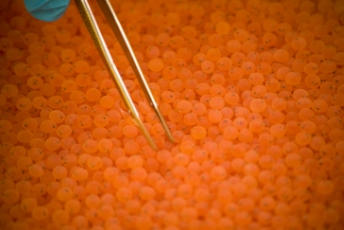
That continuity is a huge asset, not just for us, but for the world as a whole. We share our depth of historic knowledge and exchange some of our eggs, in a spirit of collaboration, so that others working in aquaculture can benefit from the genetic improvements we are continually achieving. We also research with eggs from other suppliers, so we can learn from them and benchmark the qualities of our own output.
We believe that healthy and vibrant aquaculture is key to securing the future of our planet and its people. Our unique Mowi breed is a critical resource and, by sharing and constantly developing it, we are building sustainability across the whole industry and reinforcing our position as leaders in the Blue Revolution.

Perfection is not an end but a continual process
There is no such thing as the ultimate salmon. There is only ever an optimal salmon. And that will change over time, as we explore what can be achieved by genetic selection.
Choosing genetic traits is a balancing act. If you go too far in one direction, it will have repercussions in another. So, we prioritise the importance of each characteristic of the fish we choose, tailoring their genetic traits to match the exact requirements of our farmers, customers and consumers.
Size, pigmentation, growth rate, the speed at which fish mature and the rate at which fish can convert feed into muscle and fat are among the many characteristics that can be prioritised through genetic selection. The last of these has a huge bearing on our sustainability as an industry. The less feed our salmon need to grow and thrive, the more sustainable our farming processes become.
Our breed is setting new standards in health and welfare
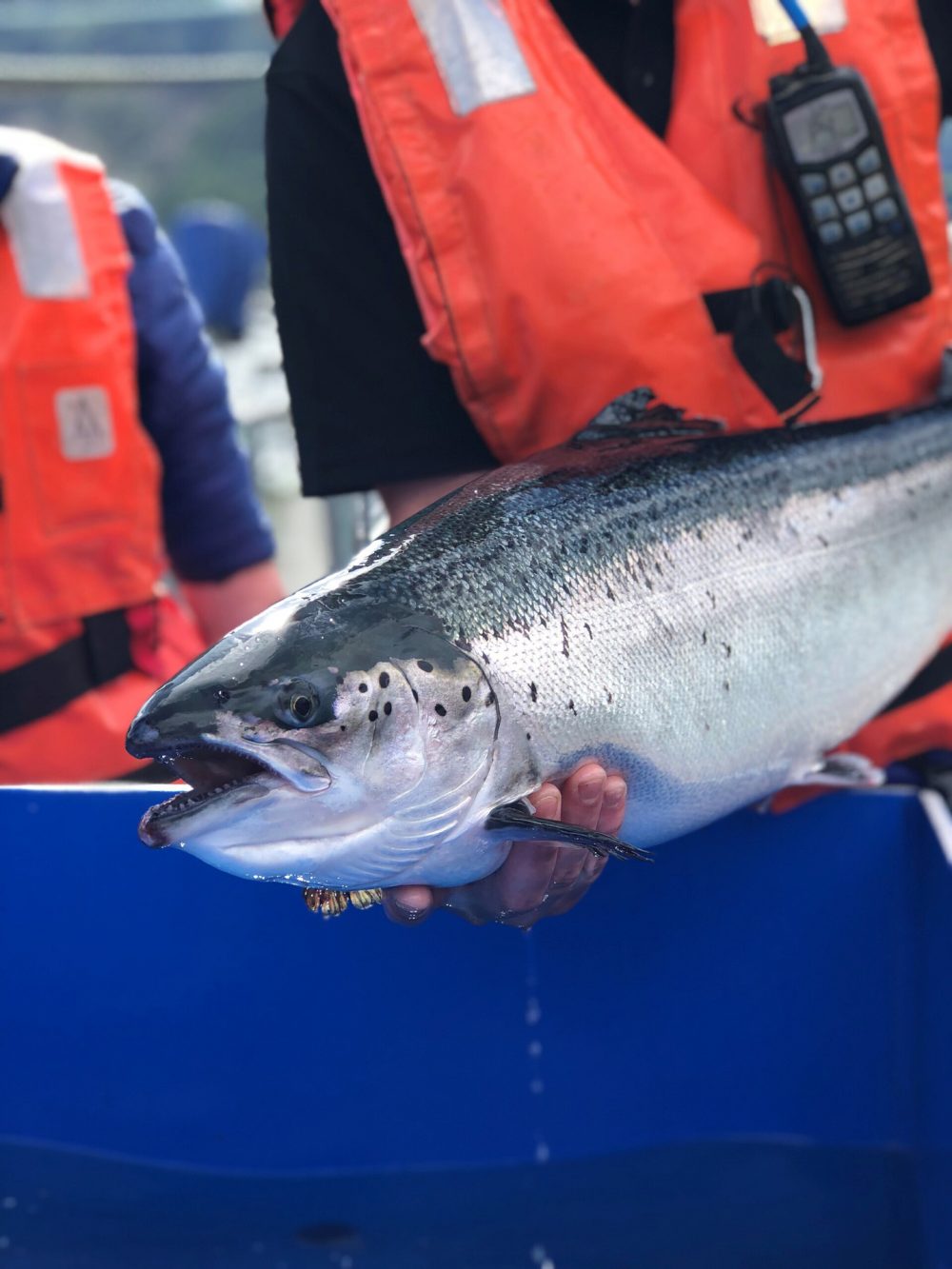
Disease and pest resistance can also be affected by genetic factors. One of our greatest recent achievements was eliminating the Infectious Pancreatic Necrosis (IPN) virus from our salmon through careful selective breeding. This demonstrates what can be achieved through deep genetic understanding of the species combined with selective breeding. We already know that Pacific salmon are significantly more resilient to sea lice and deeper understanding of the genes involved may prove valuable in addressing one of the Atlantic salmon’s most persistent problems.

Before June 10, 2014, and after
That is the date that the International Cooperation to Sequence the Atlantic Salmon Genome (ICSASG) announced the completion of a fully mapped, and openly accessible, salmon genome. We’re hugely proud to have played a key role in the international collaboration that led to this pivotal moment for our industry.
Knowing the whole genome enables us to observe and understand how salmon genes interact with one another and identify the precise gene that governs specific traits. These might include resistance to a particular disease or a nutritionally and commercially important trait such as the ability to absorb nutrients.
The difference this has made to the growth and sustainability of global aquaculture is revolutionary. It is already enabling us to set new standards across every aspect of our breeding programme and enhancing the health and sustainability of our breed. And it shows just how important it is to work collaboratively for the greater good.
Knowing where to stop is as important as progress
Recognising the limitations of a species’ genetic potential is vital. In 1999, we reached a pinnacle of size with the largest male and the largest female recorded. However, as we all know, size isn’t everything and it can actually create problems if, for example, the heart doesn’t develop at the same rate as the fish it supports.
Some breeders have experimented with creating infertile salmon to avoid escaping fish interbreeding with wild salmon, but we believe that zero escape policies are a better way to address the problem than genetic intervention which could create problems further down the line.
We have also avoided any genetic modification. To us, selecting from traits that occur naturally in salmon is a safer route to take and we are deeply conscious of the sensitivities of our consumers as well as wider ethical considerations.
Multiple “gene pens” help us guarantee the breadth of our overall gene pool and keep the Mowi breed as genetically diverse as possible.

Keeping our gene pool as wide as possible guarantees a dynamic healthy breed
Inbreeding is always a risk in any selective breeding programme whether it’s on land or at sea. It’s something we are deeply conscious of, and we go out of our way to create as rich a gene bank in our stock as possible. One of the ways we do this, is by having multiple “families” and we create 350 such families every year.
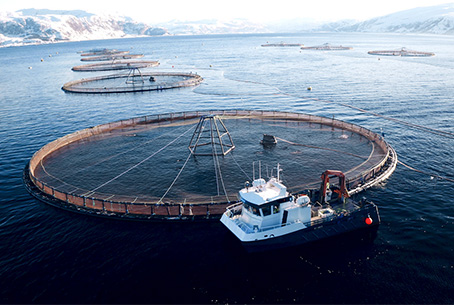
Some of these nucleus families are selected for specific traits while others are chosen for the breadth of their genetic variation. These multiple “gene pens” help us guarantee the breadth of our overall gene pool and keep the Mowi breed as genetically diverse as possible.
Protecting the Mowi legacy
All creatures are vulnerable, and salmon are no exception. In the wild, they are more heavily predated than other fish species with survival rates that can be as low as 5%. In farms, survival rates are very much higher, but they are still vulnerable to pollutants, pests and disease.
We protect our precious brood stocks by spreading them out to several different locations in Norway and Ireland. These are locations we know well and have used for decades. This ensures that if anything ever happens to compromise our fish in one environment, there will be other families to carry the breed on elsewhere. The benefit of this cautious approach is clear. The legendary Mowi breed is still going from strength to strength, over fifty years after it was born.

Being at the cutting edge of the science means we can lead from the front
We have always worked closely with universities and research establishments. Our own scientific expertise and practical understanding of salmon breeding and farming processes coupled with their depth of scientific knowledge make us a formidable combination. While they can undertake small-scale trials in their establishments, our unrivaled facilities give them a unique opportunity to upscale studies and generate more robust data to confirm or refute any findings in the lab.
This collaborative relationship with the scientific community has grown even stronger as we have invested in what we call Aquaculture 4.0. This cutting-edge technology allows us to examine salmon behaviour and performance not just at a family level, but at an individual level, so we can monitor genetic traits with unprecedented precision and accuracy. Being able to monitor a salmon’s journey at every step of the supply chain, from egg to plate, gives us a unique data loop allowing our geneticists to adjust our breed to perform better with each succeeding generation.
Because we constantly set new standards of research and innovation, we are at a considerable advantage over those that need to buy eggs from specialist breeders. Whereas they will often have to wait until new genetic variants come to market, the salmon we supply already possesses the very latest genetic advantages.